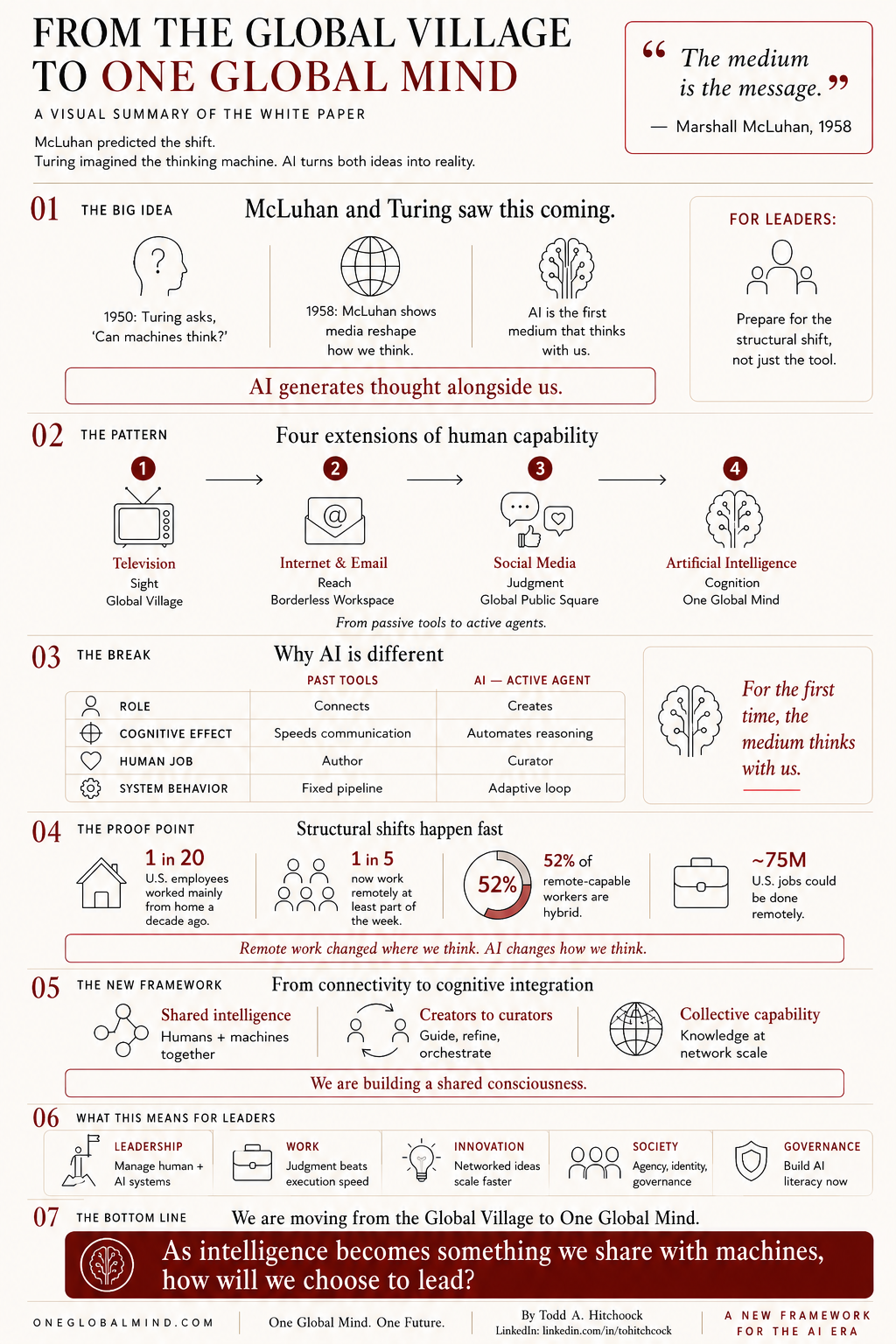
McLuhan and Turing saw this coming.
Marshall McLuhan predicted the AI age in 1958. At the time, we simply did not yet have the knowledge, the ability to conceptualize it, or to truly understand what he was describing.
He was not the only one to see it coming. A few years earlier, in 1950, the British mathematician Alan Turing asked a question that still sounds like science fiction: can a machine think? In his paper Computing Machinery and Intelligence, he proposed a now-famous test for machine intelligence and argued that we would one day build machines capable of genuine reasoning. Turing and McLuhan were working on opposite ends of the same future. Turing imagined the thinking machine. McLuhan understood what such a machine would eventually do to us. Put their two insights together and you have the blueprint for the moment we are living through right now.
McLuhan's famous line — the medium is the message — was never about content. It was about consequence. Every transformative technology reshapes how we think, work, and relate long before we notice the furniture has moved. Trace that thesis forward and a pattern emerges. Television extended our sight. The internet extended our reach. Social media externalized our judgment into a worldwide stage where our private thoughts and reactions became shared currency shaped by forces beyond our control. Each one rewired human behavior at a scale we only understood in hindsight.
Artificial intelligence is where the pattern breaks.
AI is the first medium in history that does not simply carry our thoughts. It generates them alongside us. This is the kind of thinking machine Turing imagined, now operating at global scale, and it is the extension of human cognition itself. That single difference moves us out of McLuhan's connected Global Village and into something genuinely new: One Global Mind, a continuous fabric of human and machine intelligence working as one.
This paper is written for leaders who do not have the luxury of watching from the sidelines. The argument is simple. Stop debating individual AI outputs and start preparing for the structural shift underneath them. The organizations that win the next decade will be the ones that recognize the furniture is already moving.
Four extensions of human capability.
Every major medium of the last seventy years has done the same thing: it took a human capability and pushed it outward into the environment. Viewed in sequence, the progression is not a list of gadgets. It is a steady outsourcing of ourselves.
Television turned the planet into a Global Village. It collapsed distance and gave us a shared, real-time field of view. The internet and email dissolved the boundaries of time and place — work stopped being somewhere you went and became something you did, anywhere, around the clock. Social media put our thoughts, reactions, and relationships on display in a global public square. Our private judgments became shared data, and the platforms learned to shape our behavior faster than we could track it.
Each step deepened the integration. Each one changed behavior faster than policy, theory, or comfort could keep up. The timeline below maps the arc and shows exactly where the line breaks.
Why AI is not just the next tool.
Here is the distinction that matters. Every medium before AI was a passive channel. A television does not think; it broadcasts. The internet does not write; it connects. The human mind was always the only engine of thought in the room, and the technology was just the pipeline.
AI changes the equation. When you work with a generative model, the output is the content. The message — the real consequence — is the automation of human intellect itself. For the first time, the medium thinks with you. It synthesizes, decides, and creates. It moves the human role from producing every idea to guiding, refining, and orchestrating intelligence that is no longer entirely our own.
That is not a faster version of the internet. It is a different category of technology altogether.
Structural shifts normalize faster than we expect.
If you doubt how fast a structural shift can become the new normal, look at how your own organization works today.
A decade ago, remote work was a rounding error. Roughly one in twenty U.S. employees worked primarily from home. Then the ground moved. Today, about one in five American workers are remote at least part of the week, and among employees in jobs that can be done remotely, 52% now work in a hybrid arrangement. The Bureau of Labor Statistics estimates that more than half of the non-self-employed workforce — some 75 million people — hold jobs that could be performed remotely at all.
That transformation did not take a generation. It took about five years. Offices, leases, management norms, and entire career expectations reorganized themselves around a model that barely existed in 2015.
Remote work changed where we think. AI changes how we think — and increasingly, who does the thinking.
AI is following the same curve, only faster, and aimed at something far more central than where we sit. Leaders who treat it as an optional tool to be evaluated quarter by quarter are making the same mistake as the executives who, in 2018, were still certain that real work only happened in the building.
One Global Mind: from connectivity to cognitive integration.
McLuhan's Global Village was a model of connectivity. It linked people across distance and let information travel instantly. Powerful — but the thinking still happened in individual human heads.
One Global Mind is a model of cognitive integration. Human insight and machine intelligence interweave into a single, continuous fabric. Knowledge is no longer simply passed from one person to the next. It is synthesized, calculated, and refined across the entire network at once. Three shifts define it:
Shared intelligence. Human and machine cognition increasingly operate as one system rather than two.
From creators to curators. Value moves away from producing every output and toward judgment: guiding, refining, and orchestrating.
Collective capability. Knowledge, decisions, and creativity become part of a connected global fabric, available at a scale no individual could reach alone.
We are no longer just building tools. We are building a shared consciousness — and it will not merely enhance how we work. It will change how we work, decide, and create.
What this means for leaders.
The McLuhan lesson for executives is uncomfortable but clarifying: arguing about a single AI output — whether this answer is right or that image is good — is like judging television by critiquing one commercial. The leverage is in the environment it creates, the way it reshapes how we work and live, not in any single artifact. Four implications follow.
Leadership. Your job is shifting from managing people to managing systems of people and AI. The core competency becomes designing how human judgment and machine capability combine.
Work. Competitive advantage no longer comes from execution speed. It comes from judgment, curation, and the ability to orchestrate. The premium is on knowing what to ask, what to keep, and what to trust.
Innovation. When decision making becomes networked, ideas scale faster than ever. The constraint is no longer how many smart people you can hire; it is how well you orchestrate the intelligence you already have access to.
Society. The shift raises real questions about agency, identity, and governance — questions leaders will be expected to help answer, not avoid.
None of this rewards waiting. The advantage goes to the organizations that build AI literacy now, while the rules are still being written.
Beyond the org chart.
Step back from the tools for a moment, because the deeper story is not about software. It is about what happens to work, and to people, when intelligence becomes something we share with machines.
For most of the industrial era, leadership meant optimizing the org chart: the right people in the right boxes, executing a known plan. That model is ending. The next generation of leaders will not so much manage a workforce as design a partnership between people and intelligent systems. The central question shifts from who does what task to how humans and machines make each other better.
That work cannot be done to employees. It has to be done with them. The organizations that thrive will redesign roles in the open and alongside their people, handing the repetitive and the routine to the machine and freeing human time for the things only people do well: judgment, creativity, relationships, and care. Done poorly, this becomes a story about replacement and fear. Done well, it becomes a story about elevation, where everyday work gets more human, not less.
The stakes reach well beyond any single company. As a shared mind takes shape, society will have to answer hard questions. What counts as valuable human contribution when machines can reason? Who benefits from this new capability — the few or the many? How do we govern a form of intelligence that learns and adapts on its own? These are not abstract concerns for some distant future. They are leadership questions for right now, and the executives who engage them honestly will help write the new social contract of work, not just their own quarterly results.
The plates are already moving.
The tectonic plates of human society are moving, and they are not moving back. We are crossing from the connective architecture of the Global Village to the integrated infrastructure of One Global Mind, and our measures of human value, economic contribution, and competitive edge will all have to be rewritten to match.
Leaders can no longer treat technology as a series of separate, passive instruments to be adopted one at a time. We are now navigating an active, autonomous medium that is rewriting the rules of human thought in real time. The advantage will belong to those who stop reacting to it and start designing for it.
The question for every leader: as intelligence becomes something we share with machines, how will we choose to lead through it? How do we design work so that people and intelligent systems make each other better — and what kind of society do we want this shared mind to build?
That is the conversation worth having, and it is only beginning. I would like to hear where you land. Let's continue it on LinkedIn.
Download the white paper as a PDF.
Or download the one-page infographic — the whole argument at a glance.
References & sources
- Turing, A. M. “Computing Machinery and Intelligence.” Mind, Vol. 59, No. 236, 1950.
- McLuhan, Marshall. Understanding Media: The Extensions of Man. New York: McGraw-Hill, 1964.
- McLuhan, Marshall, and Quentin Fiore. The Medium Is the Massage: An Inventory of Effects. New York: Bantam Books, 1967.
- Postman, Neil. Amusing Ourselves to Death: Public Discourse in the Age of Show Business. New York: Viking Penguin, 1985.